

Independent Product Build
Liu
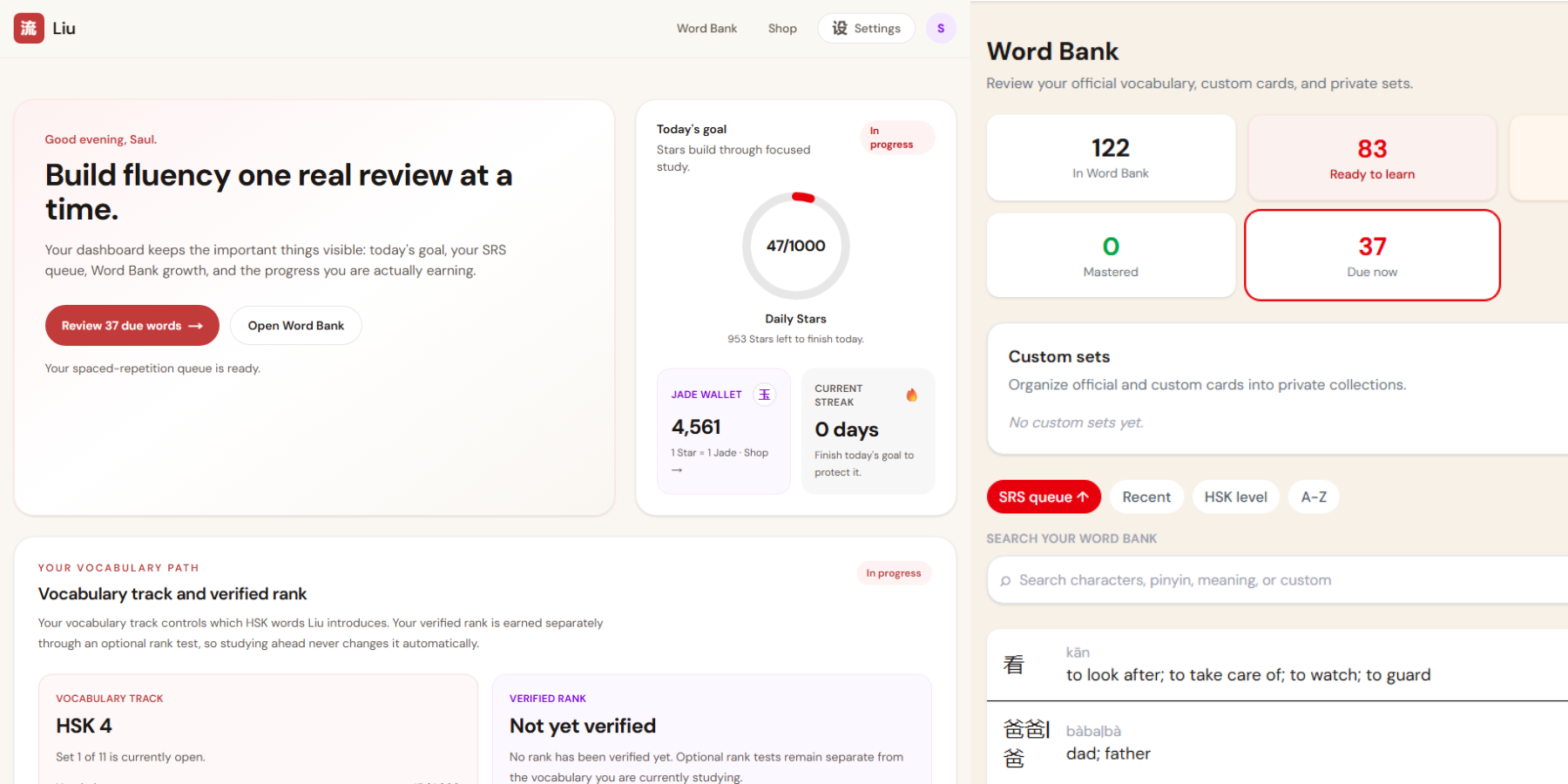
I built and launched Liu as an end-to-end product experiment in making serious Mandarin vocabulary learning easier to enter, understand, and sustain.
- Role
- Founder and Product Manager
- Category
- Independent Product Build
- Timeframe
- May 2026 — Present
- Status
- Independent Project · Open Beta
TL;DR
The case in 60 seconds
Founder and Product Manager
Independent Project · Open Beta
Problem
Language learners often rely on fragmented tools or products that make activity look like mastery. The challenge was to create a more coherent learning system without overstating what vocabulary practice alone can deliver.
Ownership
I used AI-assisted development to translate the product philosophy into explicit operating rules across positioning, onboarding, spaced repetition, progression, notifications, analytics, privacy, entitlements, and content readiness. I retained ownership of requirements, system decisions, debugging, validation, and release integrity while repeatedly narrowing or rebuilding features that did not support the learner-facing promise.
Key decisions
- Narrowed the first release from a broad fluency ecosystem to a credible vocabulary and spaced-repetition product.
- Designed placement and product value to precede account registration.
- Separated legitimate scheduled review evidence from bonus or fallback practice.
Outcome
Built and launched an open beta with a live domain, 11,092 canonical vocabulary rows across HSK 1–9, four retrieval formats, adaptive review infrastructure, product analytics, and documented product requirements and roadmap decisions. Structured evidence collection is underway, and no retention, learning-gain, or revenue claims are made yet.
Project Context
View live siteLiu is a live Mandarin vocabulary and spaced-repetition product available in open beta. It includes 11,092 canonical vocabulary rows across HSK 1–9, adaptive review, four retrieval formats, mastery progression, contextual practice where content passes eligibility requirements, progress analytics, authentication, and PWA distribution. The public beta is focused on validating the learning experience while editorial review continues across sentence-based content.
Challenge
What needed attention
Language learners often rely on fragmented tools or products that make activity look like mastery. The challenge was to create a more coherent learning system without overstating what vocabulary practice alone can deliver.
Scope correction
The right decision was to change the promise.
Liu began as an all-in-one fluency ecosystem spanning vocabulary, grammar, listening, speaking, writing, and AI conversation. A solo, low-budget build could not responsibly launch every layer at the required quality. Rather than use a broad claim to make the product appear more complete, I narrowed the first release to the systems that could be made credible.
Original ambition
A complete fluency ecosystem
- Vocabulary
- Grammar
- Listening
- Speaking
- Writing
- AI conversation
Focused open beta
A credible vocabulary foundation
- HSK progression
- Spaced repetition
- Durable recall
- Format rotation
- Contextual practice
- Flexible continuity
Product ownership
From philosophy to operating rules
I used AI-assisted development to translate the product philosophy into explicit operating rules across positioning, onboarding, spaced repetition, progression, notifications, analytics, privacy, entitlements, and content readiness. I retained ownership of requirements, system decisions, debugging, validation, and release integrity while repeatedly narrowing or rebuilding features that did not support the learner-facing promise.
Product in practice
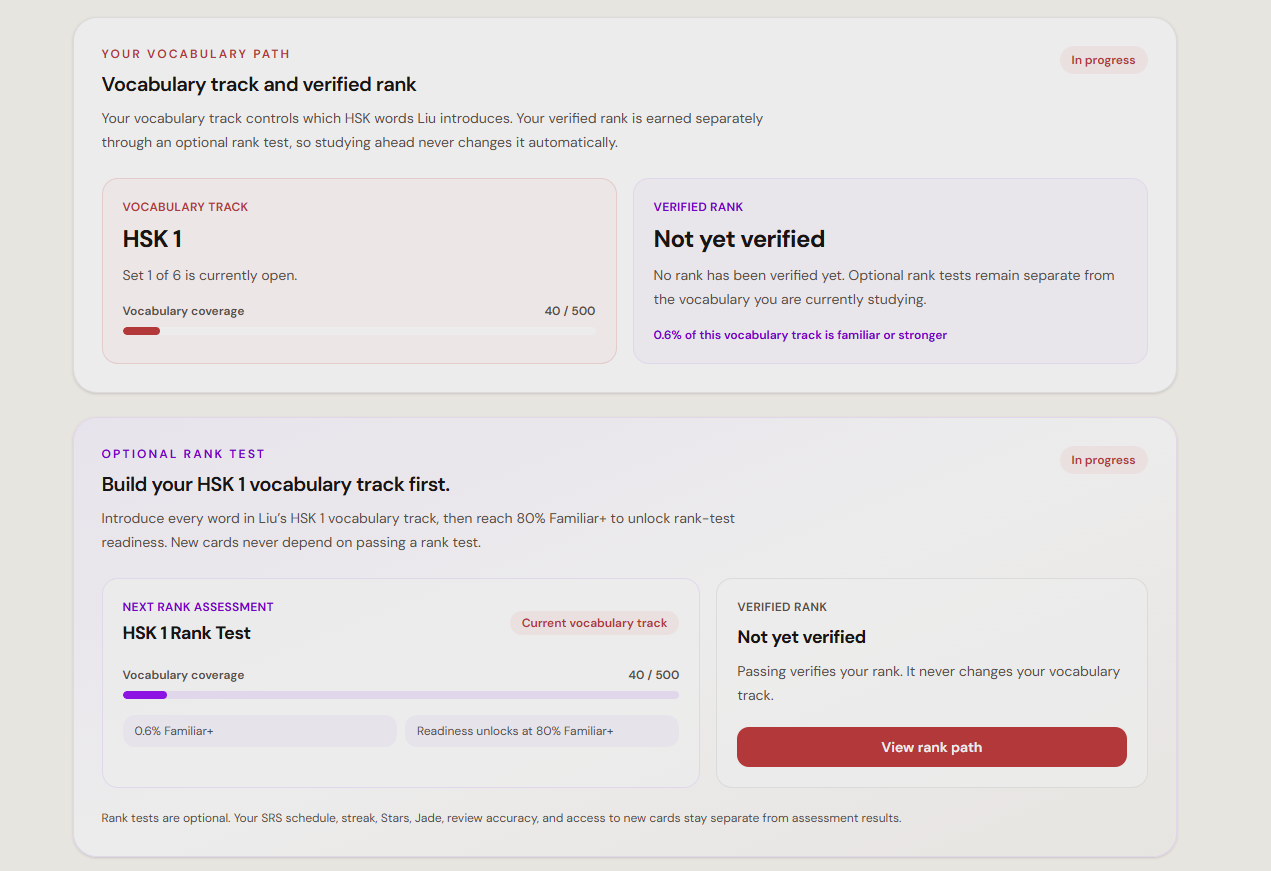
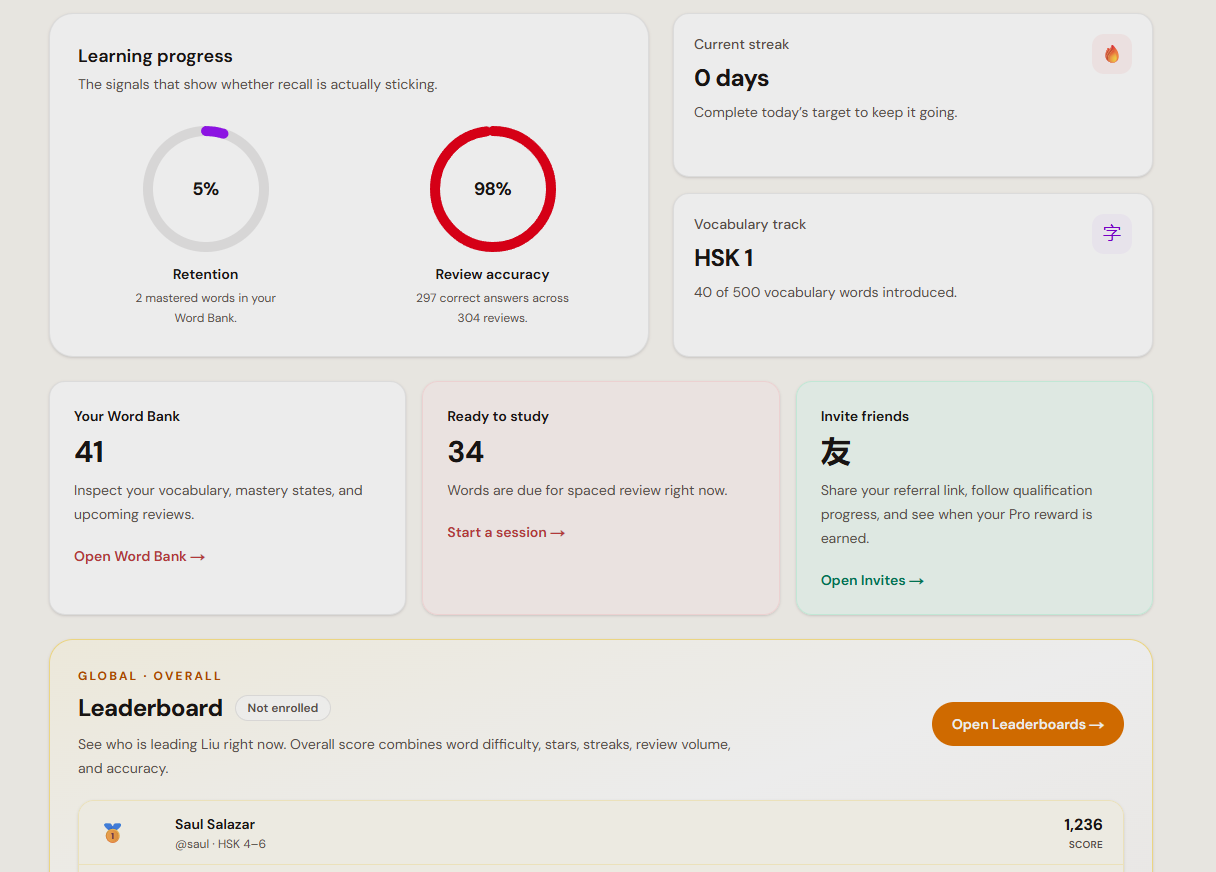
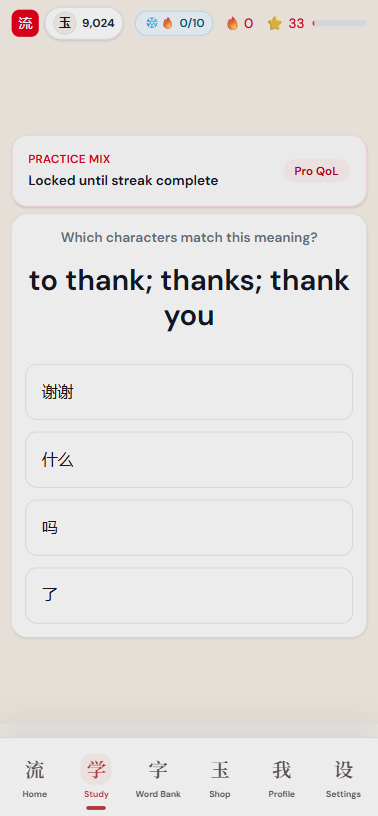
One system across the learning journey.
Placement, vocabulary progression, daily study, continuity, and progress visibility are designed as parts of one learner model rather than disconnected feature surfaces.
Learner contract
Principles expressed as system behavior.
01
Learning truth over engagement optics
Progress should represent durable retrieval, not repeated taps or bonus practice.
- Only legitimate scheduled reviews advance mastery
- Due reviews remain higher priority than fallback practice
- Every format resolves to one word-level progress record
02
Value before registration
A learner should experience the product and receive a placement result before being asked to create an account.
- Goal and product preview precede identity collection
- Three adaptive placement rounds produce a server-signed result
- Signup or claim occurs after the result, not before it
03
Serious learning without punishment
Missing a day, studying briefly, or declining a reminder should not erase credible progress or create shame.
- Frozen Flames settle missed local days automatically
- Protected days preserve continuity without inflating weekly rewards
- Streak-break messaging is one-and-done for the same break
04
Minimal useful communication
Liu should help learners return without behaving like an attention-extraction product.
- At most one automated reminder per local day
- Quiet hours and an 18-hour minimum notification gap
- Study reminders stop after the daily target is reached
Learning architecture
One word. Multiple retrieval paths.
Meaning, characters, pinyin, and contextual questions do not create separate versions of progress. Every format resolves to one authoritative learner-word record, allowing practice to vary without fragmenting mastery.
Meaning
Recognize the intended meaning of a word.
Characters
Retrieve the written form from meaning and context.
Pinyin
Connect pronunciation scaffolding to the same word record.
Context
Use sentence cloze only when content passes eligibility checks.
Authoritative model
One learner-word record
Shared accuracy, scheduling, legitimate review count, interval, and mastery state.
Learning
Scaffolding remains visible
Familiar
Time and scheduled evidence
Mastered
Longer interval, reduced pinyin
流
Long-term hidden mastery tier
Decision log
Working was not the same as being right.
The strongest product decisions came from finding places where an implementation appeared complete but violated the learner contract, evidence standard, or authority model.
Initial assumption
Why it failed
Product correction
01
Broad fluency positioning
Why it failed
The launch promise included systems that a solo V1 could not support credibly.
Product correction
Narrowed the product to vocabulary, spaced repetition, contextual understanding, and guided HSK progression.
02
Bonus reviews advanced mastery
Why it failed
Rapid repeated practice could manufacture the appearance of long-term learning.
Product correction
Only legitimate scheduled reviews may advance intervals, review floors, and mastery tiers.
03
Manual-only streak recovery
Why it failed
Owned protection did nothing when the learner never opened the app.
Product correction
Added chronological local-day settlement, a scheduled processor, login reconciliation, and an idempotent ledger.
04
Referral qualification at account creation
Why it failed
A signup that never reached the learning experience was counted as meaningful activation.
Product correction
Moved qualification after study pace is saved and the learner receives a starter vocabulary pool.
05
Analytics deferred until after launch
Why it failed
Placement, activation, pricing, and referral evidence could not be reconstructed retroactively.
Product correction
Made consent-based analytics, minimized payloads, and test/live separation an open-beta requirement.
06
Paid access and administrative authority overlapped
Why it failed
A product entitlement accidentally created a privilege-escalation path.
Product correction
Separated admin authority from subscriptions, Founder ownership, gifts, referrals, and other access grants.
07
Sentence cloze was technically functional
Why it failed
Some content could still be incomplete, ambiguous, or supported by unsafe distractors.
Product correction
Added content-readiness gates and a fallback to meaning-based practice whenever contextual certainty is insufficient.
Technical product ownership
AI-assisted implementation with retained product authority.
I used AI-assisted development to accelerate implementation while retaining ownership of requirements, system-design choices, debugging, validation, migrations, integrations, and release quality. The work demonstrates technical product fluency without presenting the project as traditional software-engineering experience.
- Next.js
- TypeScript
- Supabase
- PostgreSQL
- Row-Level Security
- Vercel PWA
- PostHog
- Sentry
- Cloudflare Turnstile
- AI-Assisted Development
Server-authoritative progression
The browser submits a server-issued attempt and the selected response. Trusted backend logic determines correctness, progression, and rewards so client state cannot manufacture learning outcomes.
Durable access resolution
Subscriptions, Founder ownership, gifts, referrals, and administrative grants remain distinct access sources. The interface displays entitlement state, but it does not define it.
Privacy-conscious analytics
Analytics is opt-in, withdrawable, and limited to product-level events. Raw answers, custom-card content, email, payment-card data, and other unnecessary identifiers are excluded.
Deliberate restraint
What did not belong in the first release.
These capabilities remain part of the longer product vision, but none were allowed to delay the vocabulary and spaced-repetition foundation or inflate the open-beta claim.
- AI conversation
- Pronunciation audio
- Listening-first recognition cards
- Speaking evaluation
- Writing evaluation
- Grammar courses
- Browser extension
- Multi-language expansion
- Broad public community features
Open beta
A functioning product, not a finished evidence story.
Liu is available in open beta. The current result is a shipped learning system and an instrumented foundation for evaluating behavior, not proof of retention, learning gains, or product-market fit.
What I can claim
- Open beta available at a live domain
- 11,092 canonical vocabulary rows across HSK 1–9
- Four retrieval formats sharing one word-level progress model
- Responsive PWA with placement, adaptive review, progress tracking, and analytics
- Documented requirements, roadmap, architecture decisions, and release constraints
What I am not claiming yet
- Demonstrated learning gains
- Improved retention against a controlled baseline
- Product-market fit
- Revenue traction
- Full-library sentence quality
- Better learner outcomes than named competitors
Evidence plan
The beta is designed to answer specific product questions.
01
Does placement-before-signup improve meaningful activation?
02
Are learners receiving varied practice without ambiguous or unfair prompts?
03
Does automatic streak protection settle missed local days correctly?
04
Do restrained notifications encourage study without increasing opt-outs?
05
Does narrower vocabulary positioning match learner expectations?
Credits
Liu
- Role
- Founder and Product Manager
- Category
- Independent Product Build
- Timeframe
- May 2026 — Present
- Status
- Independent Project · Open Beta
Related links